What Happens to Satellites at the End of Their Missions?

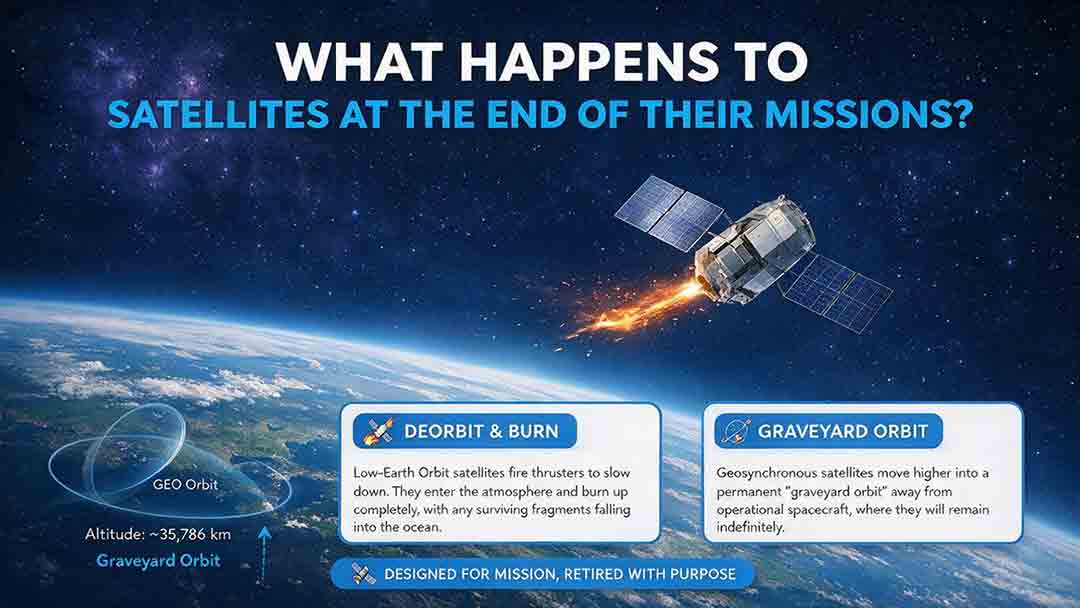
When satellites reach the end of their missions, operators normally deorbit them into the atmosphere, move them to disposal orbits, or—if control has been lost—continue tracking them as non-functional orbital objects. Responsible retirement also includes passivation, which removes or makes safe energy stored in batteries, propellant systems, pressure vessels, and mechanical hardware. The appropriate method depends mainly on orbit, remaining control, and residual risk.
Key Takeaways
- Low Earth orbit satellites are commonly removed through atmospheric reentry, either naturally or with deliberate orbit-lowering maneuvers.
- Geostationary satellites usually move above the operational GEO region into disposal orbits often called graveyard orbits.
- Passivation is different from orbital disposal. It reduces the chance that batteries, propellant, pressure vessels, or mechanical systems will later cause a breakup.
- A failed satellite may remain in orbit for years or far longer if operators cannot restore communications or maneuvering capability.
- No single disposal deadline applies worldwide. Requirements depend on the authorization, jurisdiction, orbit, spacecraft, and disposal method.
This guide explains what happens after normal operations stop, why satellites in different orbits have different endings, and what operators can do when a spacecraft fails before completing its disposal plan.
Contents
- What happens after a satellite mission ends?
- Which disposal method is used in each orbit?
- How are satellites in low Earth orbit deorbited?
- What happens to satellites in geostationary orbit?
- What happens to satellites in medium Earth orbit?
- What is spacecraft passivation?
- How can a satellite disposal method be evaluated?
- What happens if a satellite fails before disposal?
- Are satellite disposal rules the same worldwide?
- Frequently asked questions
What Happens After a Satellite Mission Ends?
Operators normally follow a planned retirement sequence rather than simply turning the satellite off.
A typical sequence includes:
- Ending routine payload operations.
- Downloading important scientific, commercial, or engineering data.
- Confirming the spacecraft’s remaining power, propellant, and control capability.
- Performing the planned deorbit or disposal-orbit maneuver.
- Venting propellant and relieving pressure where required.
- Discharging or isolating batteries and other stored-energy systems.
- Confirming the final orbit or atmospheric reentry.
- Completing required reporting and ending routine communications.
The order matters. A satellite generally needs power, communications, attitude control, and sometimes propulsion until its final maneuver has been completed. Full passivation therefore usually occurs only after the spacecraft reaches its intended disposal trajectory.
The active NASA-STD-8719.14C, Process for Limiting Orbital Debris, treats post-mission disposal and stored-energy management as distinct parts of orbital-debris prevention for applicable NASA programs and projects.
The Three-Finish Test
A satellite is not necessarily responsibly retired merely because its payload has stopped operating.
A useful way to examine retirement is to check three separate finish lines:
- Mission finish: The satellite has stopped providing its intended service.
- Orbital finish: The spacecraft has left, or is on a credible path to leave, the protected operational region.
- Energy finish: Stored electrical, chemical, pressure, and mechanical energy has been removed or made safe.
A mission can reach the first finish without reaching the other two. A communications satellite, for example, may stop serving customers while remaining in its operating slot with charged batteries and pressurized tanks.
The Three-Finish Test is an educational tool created for this article. It is not an official standard or a substitute for mission-specific engineering and regulatory analysis.
Which Disposal Method Is Used in Each Orbit?
A satellite’s orbit usually determines the broad disposal strategy, while the spacecraft’s condition determines whether that strategy can still be completed.
LEO, MEO, and GEO have different disposal constraints because altitude, orbital energy, and operating regions differ.
| Satellite location | Common disposal approach | Likely outcome |
|---|---|---|
| Very low Earth orbit | Natural decay or a small orbit-lowering maneuver | Atmospheric reentry |
| Low Earth orbit | Natural decay, assisted reentry, or controlled reentry | Most material burns up; some components may survive |
| Medium Earth orbit | Mission-specific disposal orbit or long-term reentry trajectory | Satellite remains outside important operational shells |
| Geostationary orbit | Relocation above the protected GEO region | Satellite remains in a graveyard orbit |
| Highly elliptical orbit | Reentry or a carefully selected disposal orbit | Outcome depends on long-term orbital evolution |
| Lunar or deep-space trajectory | Impact, parking orbit, heliocentric orbit, or escape | Mission-specific outcome |
| Failed satellite | Tracking, natural decay, or possible future removal | Remains non-functional unless it reenters or is removed |
These are common engineering approaches, not universal legal rules.
The final plan may also depend on:
- Spacecraft mass and construction
- Remaining propellant
- Propulsion and attitude-control reliability
- Reentry-survival analysis
- Long-term collision exposure
- National licensing conditions
- Launch and frequency authorizations
- Planetary-protection requirements
Quick Satellite End-of-Life Guide
- LEO and controllable: Perform a planned deorbit, assisted reentry, or controlled reentry.
- LEO and uncontrollable: Track the object and wait for natural orbital decay unless external removal becomes practical.
- GEO and controllable: Move above the protected GEO region and complete passivation.
- GEO and uncontrollable: Continue long-term tracking because atmospheric reentry is generally impractical.
- MEO and controllable: Select a mission-specific disposal orbit that avoids heavily used navigation regions.
- No propulsion but equipped with a drag device: Deploy the device while sufficient power and control remain available.
This guide identifies the likely direction of a disposal plan. It does not replace detailed trajectory, reliability, reentry, or regulatory analysis.
How Are Satellites in Low Earth Orbit Deorbited?
A low Earth orbit satellite is usually retired by lowering its orbit until atmospheric drag causes reentry.
Low Earth orbit, or LEO, is commonly treated as the region below approximately 2,000 kilometers. Even hundreds of kilometers above Earth, a spacecraft encounters traces of the upper atmosphere.
This drag gradually removes orbital energy. As the spacecraft descends, atmospheric density generally increases, causing the rate of orbital decay to accelerate.
A satellite remains in orbit through the balance of gravity and sideways velocity; disposal maneuvers deliberately alter that orbital energy.
Natural Orbital Decay
A satellite in a sufficiently low orbit may be allowed to reenter without a final propulsion maneuver.
Natural decay can be appropriate when:
- The predicted orbital lifetime meets applicable requirements.
- Reentry risk is acceptably low.
- The spacecraft lacks a large propulsion system.
- Passive drag can remove the satellite within the required period.
However, the method has important limitations.
Atmospheric density changes with solar activity, altitude, season, and spacecraft orientation. The exact reentry time may therefore remain uncertain until late in the descent.
Operators also cannot precisely select where surviving components will land. The satellite may continue crossing operational orbits while it decays.
Assisted Reentry
An assisted reentry uses the satellite’s remaining propulsion capability to lower its orbit and make atmospheric entry occur sooner.
Operators may lower the spacecraft’s perigee—the lowest point in its orbit—into denser atmospheric layers. Drag then completes the descent.
Assisted reentry can:
- Shorten the period during which an inactive satellite remains in LEO
- Reduce uncertainty in the final descent
- Improve the location of likely ground tracks
- Use propulsion systems that cannot support a fully controlled reentry
It provides more influence than natural decay but less targeting accuracy than controlled reentry.
Controlled Reentry
A controlled reentry uses deliberate maneuvers to direct a spacecraft into a defined atmospheric entry corridor, usually over a remote ocean region.
It normally requires:
- Sufficient reserved propellant
- Reliable engines or thrusters
- Accurate navigation
- Functioning attitude control
- Dependable ground communication
- Detailed reentry and debris-footprint analysis
NASA’s Debris Reentry material explains that controlled entry uses a more targeted trajectory than natural decay, allowing the expected debris footprint to be placed over an uninhabited region when the spacecraft remains controllable.
Controlled vs. Uncontrolled Reentry
| Factor | Uncontrolled reentry | Controlled reentry |
|---|---|---|
| Reentry time | Often uncertain until late in the descent | Planned within an operational window |
| Reentry location | Cannot be precisely selected | Directed toward a defined corridor |
| Propellant requirement | Usually lower | Usually higher |
| Spacecraft condition | May occur with limited or no control | Requires functioning critical systems |
| Risk management | Design, prediction, and statistical assessment | Targeting plus debris-survival analysis |
| Typical use | Smaller or lower-risk spacecraft | Large vehicles or spacecraft with survivable components |
Controlled reentry is not automatically required simply because a satellite appears large. The decision depends on formal analysis of the complete vehicle, its trajectory, breakup behavior, and likely surviving components.
Do Satellites Completely Burn Up?
No. Many structures break apart and burn up, but dense or heat-resistant components can reach the surface.
Survival depends on:
- Material
- Mass
- Shape
- Wall thickness
- Melting temperature
- Position inside the spacecraft
- Breakup sequence
- Entry angle and velocity
Aluminum structures may melt more readily than components made from titanium, stainless steel, or other heat-resistant materials. Tanks, reaction wheels, optical assemblies, and dense mechanical parts may require closer analysis.
NASA uses dedicated debris-assessment and reentry-modeling tools rather than assuming either that everything burns up or that the spacecraft reaches the ground intact.
What Is Design for Demise?
Design for demise means designing spacecraft components so they are more likely to break apart and burn up safely during reentry.
Possible measures include:
- Replacing high-melting-point materials where technically practical
- Reducing pressure-vessel wall thickness where safety permits
- Positioning dense components so they encounter heating earlier
- Avoiding unnecessary shielding around components that should demise
- Designing predictable structural breakup paths
Design for demise can reduce ground risk, but it does not replace a mission-specific reentry assessment.
What Happens to Satellites in Geostationary Orbit?
Most geostationary satellites are moved above the operational GEO region rather than deorbited into the atmosphere.
A geostationary satellite operates approximately 35,786 kilometers above Earth’s equator. Returning from that altitude requires far more orbital energy than most retiring GEO spacecraft can provide.
Operators therefore reserve propellant for a final series of maneuvers into a higher disposal orbit. This region is commonly called a graveyard orbit, although it is not one narrow ring in which retired satellites are stacked together.
The satellite is then passivated and permanently retired.
Does a Graveyard Orbit Remove the Satellite?
No. A graveyard orbit clears the spacecraft from the main operational GEO region, but the satellite remains in Earth orbit.
Its path can still be influenced by:
- Solar radiation pressure
- Gravitational perturbations
- Residual-energy failures
- Inaccuracies in the final maneuver
- Long-term changes in orbital shape
- Collisions with other objects
The final orbit must therefore provide adequate clearance, and the spacecraft must still be passivated.
How Is the FCC GEO Disposal Altitude Calculated?
For covered FCC-authorized geostationary space stations, 47 CFR § 25.283 specifies a minimum disposal-orbit perigee altitude:
Minimum perigee altitude = 36,021 km + (1,000 × Cᵣ × A/m)
Where:
- Cᵣ is the spacecraft’s solar-radiation-pressure coefficient and is dimensionless.
- A/m is the area-to-mass ratio in square meters per kilogram.
- The answer is a minimum perigee altitude, not the average altitude of the final orbit.
The equation applies to covered FCC-authorized geostationary space stations. It does not mean every GEO satellite worldwide is governed by the same numerical requirement.
Illustrative GEO Disposal Calculation
Consider a hypothetical satellite with:
- Cᵣ = 1.2
- A/m = 0.02 m²/kg
The calculation is:
36,021 km + (1,000 × 1.2 × 0.02) = 36,045 km
The resulting minimum perigee altitude is 36,045 kilometers.
Compared with nominal GEO altitude:
36,045 km − 35,786 km = 259 km
In this example, the minimum perigee is approximately 259 kilometers above nominal GEO altitude.
This is an independent educational calculation using hypothetical inputs. It does not describe a real satellite and must not be used as a mission plan or compliance determination.
What Happens to Satellites in Medium Earth Orbit?
MEO satellites are usually moved away from important operational regions rather than sent directly into the atmosphere.
Medium Earth orbit includes regions used by navigation constellations. A retired satellite left crossing an active navigation shell could remain a collision concern for decades or longer.
Possible disposal strategies include:
- Raising the satellite above its operational shell
- Lowering it below a protected navigation region
- Selecting an orbit that avoids repeated crossings of active constellations
- Using long-term resonances to support eventual reentry
- Moving the spacecraft into a stable storage region
- Completing passivation after the final maneuver
There is no single MEO graveyard orbit appropriate for every satellite.
Long-term gravitational effects can substantially alter an orbit. Mission planners therefore examine where the spacecraft may travel over decades or centuries, not only where it sits immediately after the final burn.
A disposal orbit that looks clear on the retirement date may be unsuitable if it later crosses a navigation constellation, LEO, or another protected region.
What Is Spacecraft Passivation?
Passivation removes or makes safe stored energy that could cause a retired spacecraft to rupture, explode, or fragment.
An inactive satellite can remain hazardous after its instruments and transmitter have been turned off.
Potential stored-energy sources include:
- Residual fuel or oxidizer
- Pressurized tanks and gas systems
- Charged batteries
- Solar arrays still connected to batteries
- Flywheels and momentum wheels
- Springs and deployment mechanisms
- Pyrotechnic systems
- Other electrical, chemical, pressure, or mechanical energy sources
A passivation sequence may involve:
- Burning or venting residual propellant
- Relieving pressure in tanks and pressure vessels
- Discharging batteries
- Isolating batteries from solar arrays
- Safing pyrotechnic devices
- Releasing stored mechanical energy
- Disabling systems that could restart unexpectedly
- Leaving safe vent paths open where appropriate
The United Nations Space Debris Mitigation Guidelines identify the depletion or safing of stored energy as an important method for reducing post-mission breakups.
The 2025 IADC Space Debris Mitigation Guidelines similarly address residual propellants, batteries, pressure vessels, flywheels, and other sources of post-mission fragmentation risk.
Why Can an Inactive Satellite Break Apart?
A retired spacecraft may remain exposed to radiation, temperature cycling, battery degradation, material aging, micrometeoroids, and debris impacts for many years.
A later tank or battery failure can turn one intact object into numerous fragments. Those fragments may threaten operational spacecraft and generate additional debris in future collisions.
Passivation reduces that risk. It does not remove the satellite or guarantee that the object can never fragment.
How Can a Satellite Disposal Method Be Evaluated?
A useful disposal decision starts with three questions: Where is the satellite, what can it still control, and what risk remains afterward?
The CosmoBasics Orbit–Control–Risk Framework organizes those questions into a practical decision process.
This framework is an educational tool created for this article. It is not an official standard or a substitute for mission-specific engineering and regulatory analysis.
1. Orbit: Which Region Must Be Cleared?
First identify the orbital region the spacecraft should leave.
- LEO: Limit the time an inactive spacecraft remains in orbit.
- GEO: Clear the protected geostationary region.
- MEO: Avoid operational navigation shells and other heavily used zones.
- Highly elliptical orbit: Analyze long-term movement through several altitude regions.
- Lunar or deep space: Consider planetary protection and interference with future missions.
2. Control: What Can the Satellite Still Do?
A theoretically possible maneuver is not necessarily a reliable disposal method.
Successful retirement may depend on:
- Propulsion
- Propellant measurement
- Attitude control
- Navigation sensors
- Electrical power
- Flight software
- Communications
- Healthy valves and pressure systems
The most realistic options are:
- Full control: Planned deorbit, controlled reentry, or precise disposal-orbit insertion.
- Limited propellant with stable control: Perigee lowering or partial relocation.
- No propulsion but a working drag device: Deploy the device while power and attitude control remain.
- Degraded attitude control: Attempt constrained or specially designed recovery maneuvers.
- Communication without disposal hardware: Continue tracking and rely on passive decay where appropriate.
- No communication or control: External tracking and possible future removal.
3. Risk: What Happens After Disposal?
The final trajectory must be evaluated beyond the first successful maneuver.
Important questions include:
- Could components survive atmospheric reentry?
- How long will the spacecraft remain in an operational region?
- Could its disposal orbit later cross another protected shell?
- Can all significant stored energy be made safe?
- Is enough propellant reserved for uncertainty?
- What happens if the final burn is incomplete?
- Can the object continue to be tracked?
- Is a backup disposal method available?
| Orbit | Control status | Main concern | Likely outcome |
|---|---|---|---|
| LEO | Fully controllable | Reentry and orbital-residence risk | Planned deorbit |
| LEO | Uncontrollable | Collision exposure before natural decay | Tracking and passive decay |
| GEO | Fully controllable | Interference with operational GEO | Disposal-orbit relocation |
| GEO | Uncontrollable | Long-term orbital congestion | Continued tracking |
| MEO | Fully controllable | Crossing navigation regions | Mission-specific disposal orbit |
| Any orbit | No control | Collision and fragmentation risk | Tracking and possible future removal |
A Disposal Maneuver Must Still Work Years Later
End-of-life planning is often described as an orbital-mechanics problem: calculate a maneuver and reserve the required velocity change.
In practice, disposal is also a reliability problem. The satellite must preserve enough power, propellant, communications, navigation, software, and attitude control to execute the maneuver after years of radiation exposure, temperature cycling, and component wear.
A disposal plan is not strong merely because the maneuver is physically possible. It is strong when the spacecraft has a credible probability of completing that maneuver after its operational lifetime.
The 2019 U.S. Government Orbital Debris Mitigation Standard Practices also treat disposal reliability as part of post-mission planning rather than assuming every planned maneuver will succeed.
What Happens If a Satellite Fails Before Disposal?
A satellite that loses communication, propulsion, or attitude control may remain in orbit even when its original plan included responsible disposal.
Operators normally attempt recovery before declaring a spacecraft permanently lost.
Satellite Recovery Checklist
- Try primary and backup ground stations, antennas, and communication frequencies.
- Check safe-mode status, electrical power, and basic telemetry.
- Reboot or switch to backup equipment when approved mission procedures permit it.
- Restore attitude control and assess the propulsion system.
- If only partial control returns, perform a reduced disposal maneuver where safe and feasible.
- If recovery fails, update orbital information and continue tracking the object.
Ground communications are central to this process because operators exchange commands and telemetry with spacecraft through ground stations.
If control cannot be restored, other operators may maneuver around the failed satellite when conjunction warnings indicate a close approach. The failed spacecraft itself cannot move out of the way.
Can Another Spacecraft Remove It?
Potentially, but active debris removal is not yet the routine outcome for most failed satellites.
A removal spacecraft may need to:
- Approach an uncooperative target
- Estimate its tumbling motion
- Navigate without assistance from the target
- Capture or attach to it
- Stabilize the combined vehicles
- Move both objects into a disposal trajectory
Older spacecraft often lack standardized grapple fixtures, navigation markers, or servicing interfaces.
As reviewed on August 3, 2026, ESA’s official ClearSpace-1 page identifies the approximately 95-kilogram PROBA-1 satellite as the target and lists a planned 2029 launch.
ESA describes the mission as a demonstration of rendezvous with, capture of, and removal of an unprepared and uncooperative object. Earlier mission plans used a different target, illustrating why future mission details should always be tied to a review date.
The launch schedule, technical design, and mission baseline may change as development continues.
What Should Mission Designers Plan Before Launch?
The most dependable end-of-life capability is designed into the satellite before it reaches orbit.
Waiting until the final months of a mission is too late to add propulsion, passivation valves, backup radios, drag devices, or capture interfaces.
End-of-Life Design Checklist
- Define a primary disposal method.
- Define a credible backup method.
- Reserve propellant specifically for retirement.
- Include propellant-measurement uncertainty in the reserve.
- Protect disposal-critical systems from single failures where practical.
- Assess the probability of successful disposal.
- Model long-term orbital evolution.
- Analyze reentry and surviving-debris risk.
- Include battery-discharge capability.
- Include safe tank and pressure-vessel venting.
- Prevent loose hardware from becoming separate debris.
- Consider design-for-demise methods.
- Consider drag devices or external deorbit modules where appropriate.
- Add tracking aids or capture interfaces where practical.
- Reassess disposal margins before extending the mission.
When Should a Mission Be Extended?
A satellite may remain commercially or scientifically useful near the end of its planned lifetime. Extending operations can therefore create real value.
However, additional operations may consume disposal propellant, battery life, reaction-wheel life, thruster cycles, redundant hardware, and communications margin.
A mission should be extended only when the satellite can continue operating while preserving an acceptable probability of completing its disposal plan.
What Are the Most Common Misunderstandings?
“Every Old Satellite Eventually Falls to Earth”
Not necessarily. Low satellites may reenter, while objects in higher orbits can remain for very long periods.
Geostationary satellites are normally relocated instead of being returned to Earth.
“A Graveyard Orbit Removes the Satellite”
No. It moves the satellite away from the main operational GEO region, but the spacecraft remains in orbit.
Passivation is still necessary to reduce fragmentation risk.
“Everything Burns Up During Reentry”
No. Many parts burn up, but dense or heat-resistant components may survive.
The result depends on materials, structure, trajectory, and breakup behavior.
“Turning Off the Radio Is Passivation”
No. Passivation addresses propellant, batteries, pressure vessels, mechanical devices, and other stored-energy sources—not only communications.
“The 25-Year Rule Applies Everywhere”
No. A 25-year benchmark appears in several historical standards and practices, but it is not one universal legal deadline for every satellite.
Some regulators and organizations apply shorter timelines or mission-specific conditions.
“The FCC Five-Year Rule Covers Every Satellite”
No.
As reviewed on August 3, 2026, paragraph (e) of 47 CFR § 25.283 applies to covered space stations that:
- End their missions in, or pass through, LEO below 2,000 kilometers
- Plan disposal through uncontrolled atmospheric reentry
- Operate under an applicable FCC authorization
For covered spacecraft, disposal must be completed as soon as practicable and no later than five years after the end of mission as defined by that regulation.
Other jurisdictions, authorizations, controlled-reentry plans, and mission types may use different requirements.
Are Satellite Disposal Rules the Same Worldwide?
No. Regulations, agency standards, policies, technical guidelines, and voluntary commitments have different scopes and legal effects.
| Document type | Example | General role |
|---|---|---|
| Regulation | 47 CFR § 25.283 | Legally binding within the scope of covered authorizations |
| Agency technical standard | NASA-STD-8719.14C | Applies within its stated NASA program and project scope |
| Agency policy | ESA Space Debris Mitigation Policy | Governs relevant ESA activities and projects |
| International guideline | UN Space Debris Mitigation Guidelines | Establishes shared principles but is not itself international law |
| Technical guideline | IADC Space Debris Mitigation Guidelines | Provides technical recommendations for agencies and mission planners |
| Voluntary commitment | Zero Debris Charter | Expresses non-binding goals adopted by participating organizations |
A document’s authority depends on its scope.
For example:
- A NASA standard does not automatically regulate every commercial or foreign satellite.
- An FCC rule applies within the limits of relevant FCC authority.
- ESA policy governs applicable ESA activities, not every European mission.
- UN guidelines can influence national law but do not automatically become domestic legislation.
- IADC recommendations may be implemented through licenses, contracts, or agency rules.
- A voluntary charter does not replace applicable law.
The current ESA Space Debris Mitigation Policy describes ESA’s policy for applicable agency activities and its objective of working toward zero debris by 2030.
This article provides general educational information and does not replace mission-specific engineering, reentry-safety, licensing, regulatory, or legal advice.
Real-World Example: Aeolus Assisted Reentry
ESA’s Aeolus satellite shows how operators can reduce risk even when a spacecraft was not originally designed for a fully controlled reentry.
Aeolus completed its wind-observation mission in 2023 while orbiting at approximately 320 kilometers. ESA used its remaining propellant to conduct a sequence of orbit-lowering maneuvers rather than allowing the satellite to descend entirely on its own.
The maneuvers lowered Aeolus to approximately 120 kilometers and positioned its final ground tracks so that any surviving pieces would be more likely to fall along an Atlantic corridor. ESA reported that Aeolus reentered above Antarctica on July 28, 2023.
The official mission account is available at Aeolus: A Historic End to a Trailblazing Mission.
The case illustrates three practical lessons:
- Remaining propellant is useful only while the spacecraft remains controllable.
- Assisted reentry can reduce uncertainty without providing fully controlled targeting.
- Disposal is more reliable when the required capability is included in the original spacecraft design.
Aeolus was a mission-specific operation, not a universal procedure. Its result depended on its orbit, remaining propellant, functioning hardware, engineering analysis, and mission-control team.
What Is the Practical Answer?
LEO satellites are commonly retired through natural decay, assisted reentry, or controlled reentry. GEO satellites normally move into higher disposal orbits, while MEO spacecraft require mission-specific strategies that avoid important operational shells.
A satellite that fails before disposal may remain as a tracked orbital object for years or much longer. The strongest end-of-life plan is therefore designed before launch and protected throughout the mission.
Recommended Next Steps
- General readers: Identify whether the satellite is in LEO, MEO, or GEO; its orbital region usually reveals the most likely outcome.
- Students and educators: Treat mission completion, orbital disposal, atmospheric reentry, and passivation as related but separate concepts.
- Satellite observers: Remember that uncontrolled-reentry predictions can change as tracking data and atmospheric estimates improve.
- Mission professionals: Verify current licensing requirements, preserve disposal margins, and attach review dates to changing regulations and future mission plans.
Frequently Asked Questions
Can a Satellite Continue Operating After Its Planned Mission Ends?
Yes. Operators may extend a mission when the satellite remains healthy, useful, and adequately fueled.
A responsible extension should preserve enough power, communication capability, attitude control, and propellant to complete the applicable disposal plan.
How Long Can a Dead Satellite Stay in Orbit?
A failed satellite may remain in orbit for months, decades, centuries, or longer.
Its lifetime depends on altitude, orbit shape, atmospheric drag, solar activity, spacecraft orientation, area-to-mass ratio, and whether a disposal maneuver was completed.
Can Retired Satellites Be Recycled in Space?
Potentially. Future servicing spacecraft may refuel satellites, reuse components, process materials, or move existing hardware into new roles.
These technologies are still developing and are not the normal end-of-life path for most current satellites.
Who Is Responsible After a Satellite Stops Working?
Responsibility depends on applicable international agreements, national law, licenses, ownership arrangements, launch responsibilities, and mission contracts.
A spacecraft does not automatically become legally ownerless merely because it stops functioning. The specific answer may require qualified legal advice in the relevant jurisdiction.
Is a Graveyard Orbit Permanently Safe?
No orbital region is completely risk-free.
Gravitational effects, solar radiation pressure, maneuver errors, residual energy, and collisions can alter a retired satellite’s path. Appropriate clearance, passivation, and continued tracking remain important.
How This Article Was Reviewed
This article was checked against the following official materials:
- The current text of 47 CFR § 25.283
- NASA-STD-8719.14C
- NASA Orbital Debris Program Office reentry material
- The 2019 U.S. Government Orbital Debris Mitigation Standard Practices
- ESA space-debris mitigation policy and technical resources
- ESA’s current ClearSpace-1 mission page
- ESA’s Aeolus assisted-reentry account
- The United Nations Space Debris Mitigation Guidelines
- The 2025 IADC Space Debris Mitigation Guidelines
The FCC GEO formula and hypothetical numerical example were recalculated independently. Regulatory and future-mission details were last checked on August 3, 2026.
This article was not reviewed or endorsed by NASA, ESA, the FCC, the United Nations, IADC, or any other cited organization.
Sources
NASA — Process for Limiting Orbital Debris, NASA-STD-8719.14C
Active NASA technical standard addressing orbital-debris assessments, disposal, passivation, and reentry risk. Accessed August 3, 2026.NASA Orbital Debris Program Office — Debris Reentry
Official explanation of natural decay, controlled reentry, spacecraft breakup, and reentry-survival analysis. Accessed August 3, 2026.Electronic Code of Federal Regulations — 47 CFR § 25.283
Current eCFR text covering end-of-life disposal for applicable FCC satellite authorizations. Accessed August 3, 2026.U.S. Government Orbital Debris Mitigation Standard Practices, 2019 Update
U.S. government practices addressing post-mission disposal, disposal reliability, reentry risk, MEO storage, and GEO relocation. Accessed August 3, 2026.United Nations — Space Debris Mitigation Guidelines
International guidelines addressing debris releases, breakups, stored energy, collision risk, and post-mission disposal. Accessed August 3, 2026.UNOOSA — 2025 IADC Space Debris Mitigation Guidelines
Current IADC guidelines covering debris prevention, passivation, disposal, collision prevention, and reentry considerations. Accessed August 3, 2026.ESA — Space Debris Mitigation Policy
ESA policy addressing orbital-debris prevention, post-mission disposal, reentry safety, and its zero-debris objective. Accessed August 3, 2026.ESA — ClearSpace-1
Current ESA mission page identifying PROBA-1 as the target and listing a planned 2029 launch. Accessed August 3, 2026.ESA — Aeolus: A Historic End to a Trailblazing Mission
Official account of the Aeolus assisted reentry on July 28, 2023. Accessed August 3, 2026.
Update History
- August 3, 2026: Publication-ready version prepared. FCC disposal requirements, the GEO disposal formula, ClearSpace-1 mission details, and current NASA, ESA, UN, and IADC materials were reviewed.
- Future updates: Material changes to regulations, agency standards, ClearSpace-1 plans, or debris-mitigation requirements will be recorded here.
This article was checked against the official regulatory, technical, and mission sources listed above. It provides general educational information and does not replace mission-specific engineering, safety, licensing, regulatory, or legal advice.
More from Orbits, Tracking & Ground Systems
What Is a Satellite Ground Station?
A satellite ground station is the Earth-based link that allows spacecraft to exchange information with operators, processing systems, and data users. This guide explains how ground stations receive telemetry and payload data, support spacecraft tracking, and transmit authorized commands. It follows a satellite contact from pass prediction and antenna pointing through signal acquisition, decoding, terrestrial delivery, and mission use. Readers will also learn how antennas, amplifiers, modems, tracking systems, software, and networks work together; why location and orbit geometry matter; and how to estimate usable data from a single pass. The article includes an original PASS compatibility framework, a worked data-capacity example, a private-versus-managed-service comparison, a troubleshooting table, and a practical selection checklist. It also distinguishes ground stations, ground segments, and earth stations while explaining the engineering, security, licensing, and operational limits that mission teams must consider.

How to Track Satellites From Your Location
Tracking a satellite from your location becomes much easier once you know how to read a pass prediction. This practical guide explains how to select a reliable satellite tracker, confirm your observing location and local time, and interpret appearance direction, azimuth, elevation, maximum height, and visibility status. It provides a step-by-step beginner workflow for finding the International Space Station and other visible satellites, along with a comparison of tracking tools, a troubleshooting table, and a reusable observation log. Readers will also learn why a satellite may be above the horizon but remain invisible, how to distinguish satellites from aircraft, and how weather, local obstructions, outdated orbital data, and phone compass errors affect results. The guide includes the original CosmoBasics Local Pass Readiness Score for comparing viewing opportunities, plus advanced notes on TLE, GP, OMM, and the satellite catalog changes introduced in 2026.

How Do Satellites Stay in Orbit Without Falling?
Satellites stay in orbit because gravity continually pulls them toward Earth while their sideways velocity carries them forward fast enough to keep missing the surface. This guide explains that balance through clear orbital mechanics, a worked calculation for a simplified 400-kilometer circular orbit, and a one-second example showing how gravity bends a satellite’s path. It also compares low Earth orbit, medium Earth orbit, and geostationary orbit, explaining why orbital speed decreases as altitude increases. Readers will learn why satellites do not need continuous engine thrust, why the International Space Station requires periodic reboosts, how atmospheric drag and other disturbances change real orbits, and why inactive satellites can continue circling Earth. Practical tables, a three-check orbit framework, troubleshooting guidance, and a reality-check checklist help readers evaluate claims about satellites falling, drifting, reentering, or appearing stationary above one location.
Explore More Topics

How Do Satellites Detect Wildfires and Smoke?
Satellites detect wildfires by measuring unusual heat in infrared wavelengths, while visible, multispectral, and aerosol observations help analysts follow smoke across the atmosphere. This guide explains how systems such as GOES, VIIRS, MODIS, Landsat, and Sentinel contribute different pieces of the wildfire-monitoring picture. Readers will learn why a thermal hotspot is not the same as an exact fire perimeter, why satellite smoke imagery cannot replace ground-level PM2.5 measurements, and how clouds, terrain, viewing geometry, and satellite overpass timing can affect detection. The article also compares commonly used fire and smoke products, explains fire radiative power and the Normalized Burn Ratio, and provides a practical framework for choosing the right map. A documented Camp Fire example shows how multiple satellite and surface datasets can complement one another. Satellite information is valuable for situational awareness, but official emergency agencies remain the appropriate source for evacuation orders, road closures, and immediate safety decisions.

How Are Satellite Images Used in Agriculture?
Satellite images help farmers, agronomists, researchers, insurers, and public agencies monitor agricultural land across fields, regions, and growing seasons. This guide explains how optical, radar, thermal, and microwave satellite observations support crop-development monitoring, irrigation analysis, field mapping, flood and drought assessment, crop classification, and regional production forecasting. It distinguishes what satellites directly observe from calculated indices, classification results, and modeled estimates such as evapotranspiration. Readers will also learn how NDVI works, why spatial resolution and image timing matter, and when drones or field scouting are more appropriate. The original CosmoBasics SCALE Framework provides a practical way to decide whether satellite imagery fits a specific agricultural problem. Documented examples from USDA and OpenET show how operational products combine multiple observations, reference data, weather information, and models. Throughout the guide, satellite imagery is treated as a screening and monitoring tool—not a substitute for field verification, laboratory testing, or professional agricultural judgment.
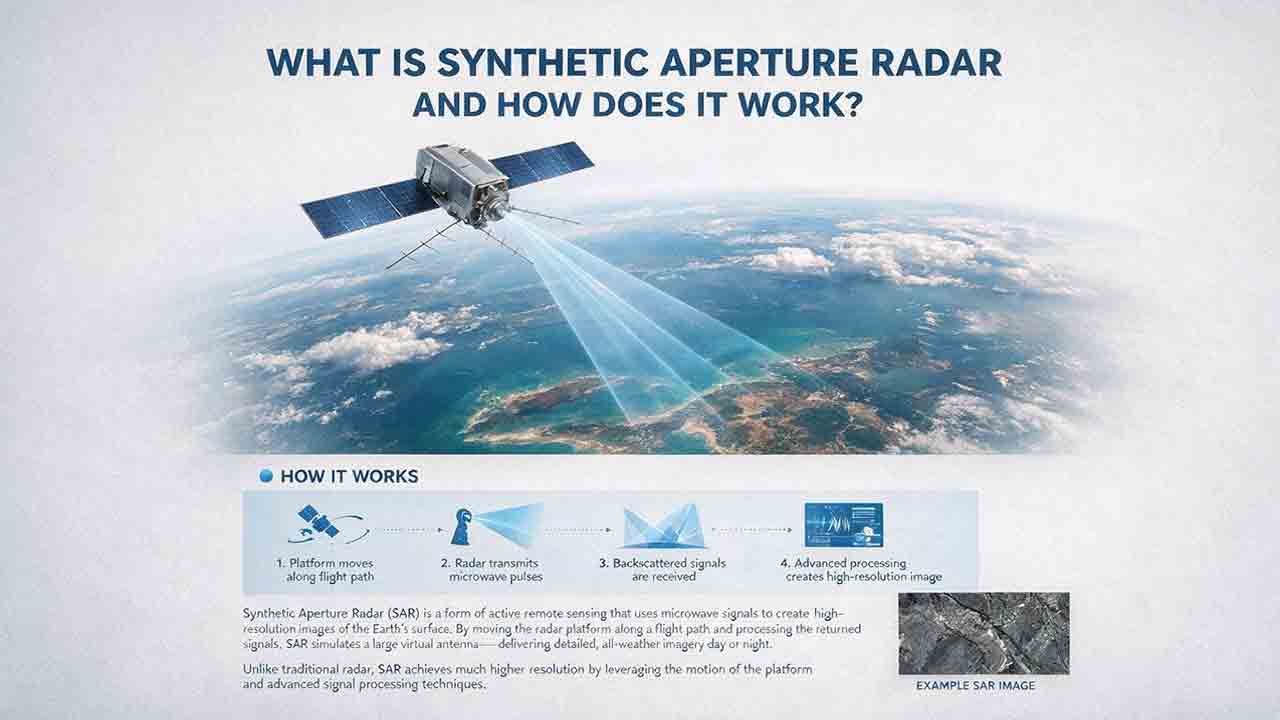
What Is Synthetic Aperture Radar and How Does It Work?
Synthetic aperture radar, or SAR, is an active Earth-observation technology that creates detailed images by transmitting microwave pulses and measuring the echoes returned from the surface. This article explains how a moving satellite or aircraft collects repeated observations to form a virtual antenna, why SAR can operate at night and through most cloud cover, and how amplitude, phase, wavelength, polarization, surface roughness, moisture, and viewing geometry affect radar imagery. It also distinguishes pixel spacing from true spatial resolution, provides a transparent range-resolution calculation, and compares SAR with optical satellite imagery. Practical sections examine scattering mechanisms, flood mapping, agriculture, forests, ice, maritime monitoring, and InSAR-based ground-deformation analysis. Original interpretation and data-selection frameworks help readers evaluate backscatter patterns, choose suitable products, identify common errors, troubleshoot unexpected results, and communicate uncertainty without treating derived radar products as guaranteed ground truth.